Annual Reports
Comcast Corporation's annual reports contain management's most considered account of the business. These are the sections, passages and visual pages worth opening in the originals preserved in Sources.
Comcast Corporation — FY2025 Annual Report (Form 10-K) — FY2025
The latest 10-K, filed weeks after the Jan-2026 Versant cable-networks spin-off reshaped the Media segment and the reporting story. · Open the full document →
Item 1: Business — p. 5 · Read the full section →
How Comcast defines itself today — two businesses, five segments — and the Versant spin-off that carved the declining cable networks out.
The business in management's words, and the January 2026 Versant separation.
We are a global media and technology company that reaches customers, viewers and guests worldwide through the connectivity and platforms services we provide and the content and experiences we create. We deliver broadband, wireless, video and voice services primarily under the Xfinity, Comcast Business, Sky and NOW brands; produce, distribute and stream leading entertainment, sports and news through brands including NBC, Telemundo, Universal, Peacock and Sky; and own and operate Universal theme parks. […] On January 2, 2026, we completed the previously announced separation of Versant Media Group, Inc. (“Versant”) into an independent, publicly traded company with its Class A common stock listed on The Nasdaq Stock Market under the ticker symbol “VSNT” (the “Separation”).
p. 5 · Read in context →
Item 1A: Risk Factors — p. 34 · Read the full section →
The two risks most specific to Comcast: the secular decline of linear video, and the Roberts family's non-dilutable control.
Cord-cutting: linear video losses accelerate as consumers shift to streaming.
Changes in consumer behavior continue to adversely affect our businesses and challenge existing business models. […] As consumers increasingly turn to DTC streaming services in lieu of linear video services, which continue to experience accelerated net customer losses, our video customers and video revenues, and linear television network subscriber fees received from video service providers, each decrease.
p. 35 · Read in context →
Item 7: Management's Discussion and Analysis — Overview — p. 52 · Read the full section →
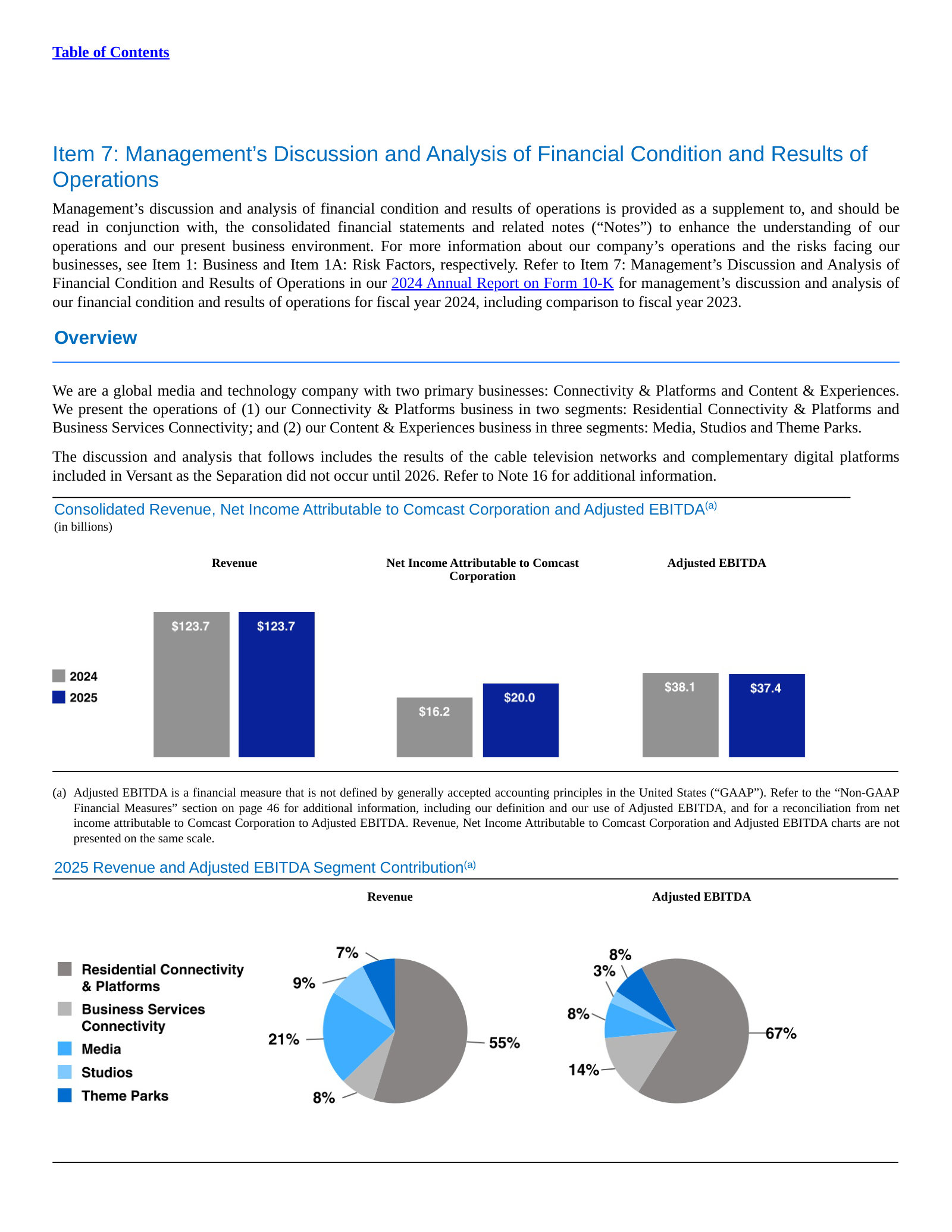
Management's framing of the year: flat $123.7B revenue, net income up to $20.0B, Adjusted EBITDA easing to $37.4B.
The current two-business, five-segment reporting structure.
We are a global media and technology company with two primary businesses: Connectivity & Platforms and Content & Experiences. We present the operations of (1) our Connectivity & Platforms business in two segments: Residential Connectivity & Platforms and Business Services Connectivity; and (2) our Content & Experiences business in three segments: Media, Studios and Theme Parks.
p. 52 · Read in context →
Segment Operating Results — p. 60 · Read the full section →
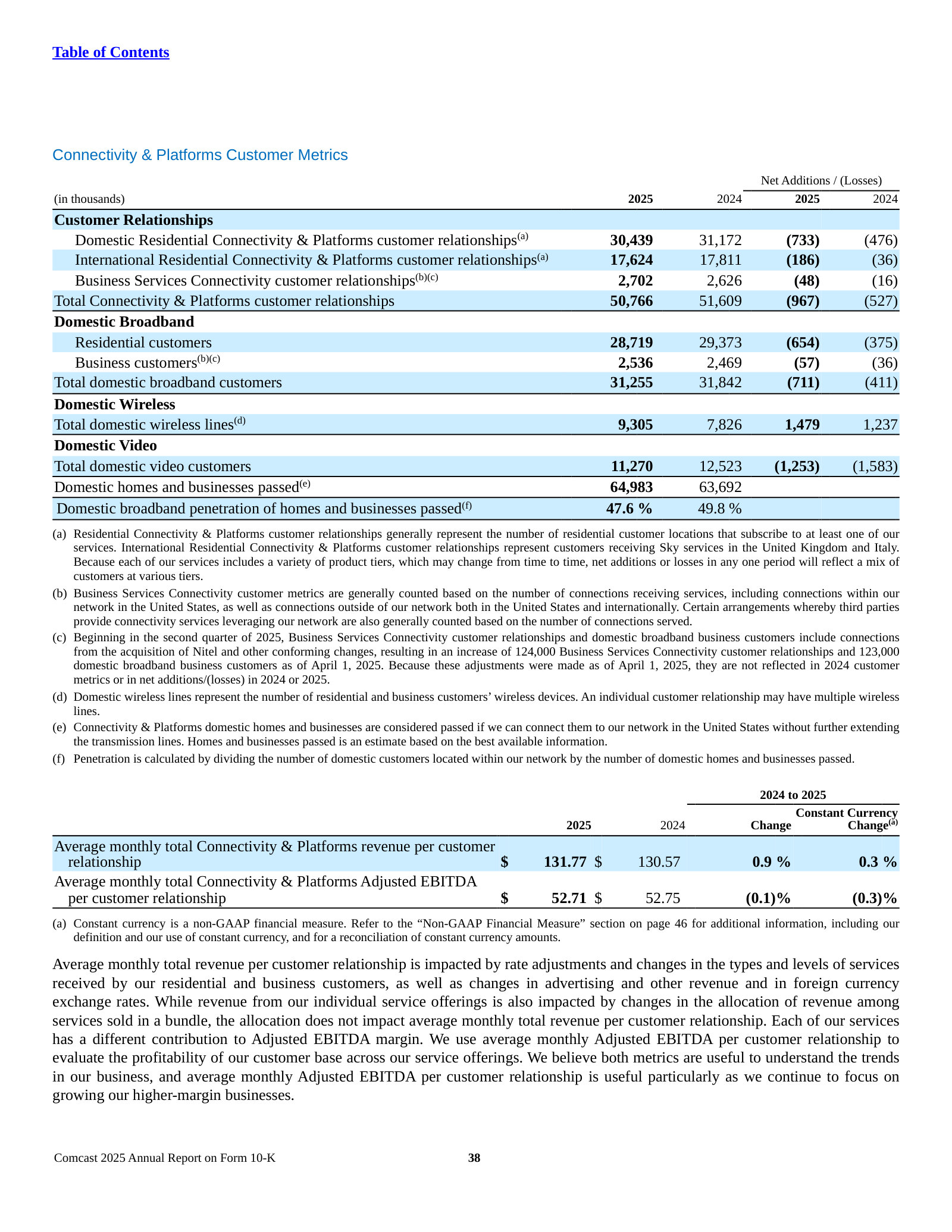
Where the operating truth lives: broadband customer losses against wireless-line and business-services gains.
Management concedes customer relationships hit by an increasingly competitive environment.
We continue to focus on growing our higher-margin connectivity businesses while managing overall operating costs. We also continue to invest in our network to support higher-speed broadband offerings and to expand the number of homes and businesses passed. Our customer relationship additions/(losses) continue to be negatively impacted by an increasingly competitive environment.
p. 60 · Read in context →
Liquidity and Capital Resources — Share Repurchases and Dividends — p. 79 · Read the full section →
The capital-return engine: how much cash went back to shareholders and what authorization remains.
Critical Accounting Estimates — p. 90 · Read the full section →
The judgments that define a cable-and-content balance sheet: goodwill, cable franchise rights, and film/TV cost accounting.
Impairment of goodwill and cable franchise rights, and film/TV costs, are the critical estimates.
We believe our estimates associated with the valuation and impairment testing of goodwill and cable franchise rights and the accounting for film and television costs are critical in the preparation of our consolidated financial statements.
p. 90 · Read in context →
Comcast Corporation — FY2022 Annual Report (Form 10-K) — FY2022
The pre-restructuring company — three businesses (Comcast Cable, NBCUniversal, Sky) — before the 2023 recut Comcast reports under today. · Open the full document →
Item 1: Business — p. 5 · Read the full section →
The old operating map — Comcast Cable / NBCUniversal / Sky — before the 2023 recut into Connectivity & Platforms and Content & Experiences.
The prior three-business, five-segment structure now superseded.
We are a global media and technology company with three primary businesses: Comcast Cable, NBCUniversal and Sky. We were incorporated under the laws of Pennsylvania in December 2001. Through our predecessors, we have developed, managed and operated cable systems since 1963. Through transactions in 2011 and 2013, we acquired NBCUniversal, and in 2018, we acquired Sky. […] We present our operations in five reportable business segments: (1) Comcast Cable in one reportable business segment, referred to as Cable Communications; (2) NBCUniversal in three reportable business segments: Media, Studios and Theme Parks (collectively, the “NBCUniversal segments”); and (3) Sky in one reportable business segment.
p. 5 · Read in context →
More annual reports
Comcast Corporation — FY2024 Annual Report (Form 10-K) — FY2024 · 157 pages · Last 10-K before the Versant spin-off; full-year baseline for the current segment structure. · Open →
Comcast Corporation — FY2023 Annual Report (Form 10-K) — FY2023 · 158 pages · First 10-K under the Connectivity & Platforms / Content & Experiences segment framework. · Open →
Comcast Corporation — FY2021 Annual Report (Form 10-K) — FY2021 · 170 pages · Peak-pandemic broadband year under the old Cable/NBCUniversal/Sky structure. · Open →